NDI Broadcast Output
Send Kairos's verse overlays into your live production switcher as a first-class NDI source.
Kairos doesn't replace your live production tooling, it plugs into it. The broadcast pipeline emits verse overlays as a standard NDI source, the same way a camera or graphics machine would, so any NDI-aware switcher can consume it.
Discoverable on the network
Once Kairos is broadcasting, any tool on the same network can pick it up. Common consumers:
- vMix: Add → NDI / Desktop Capture → your Kairos source name.
- OBS with the obs-ndi plugin: Sources → NDI Source.
- Resolume, TriCaster, Wirecast, Tessera: all NDI-native.
You set the source name in Settings → Broadcast, so multi-stage churches can run one Kairos per room with stable names like "Sanctuary" and "Chapel" and each room sees its own.
Frame format
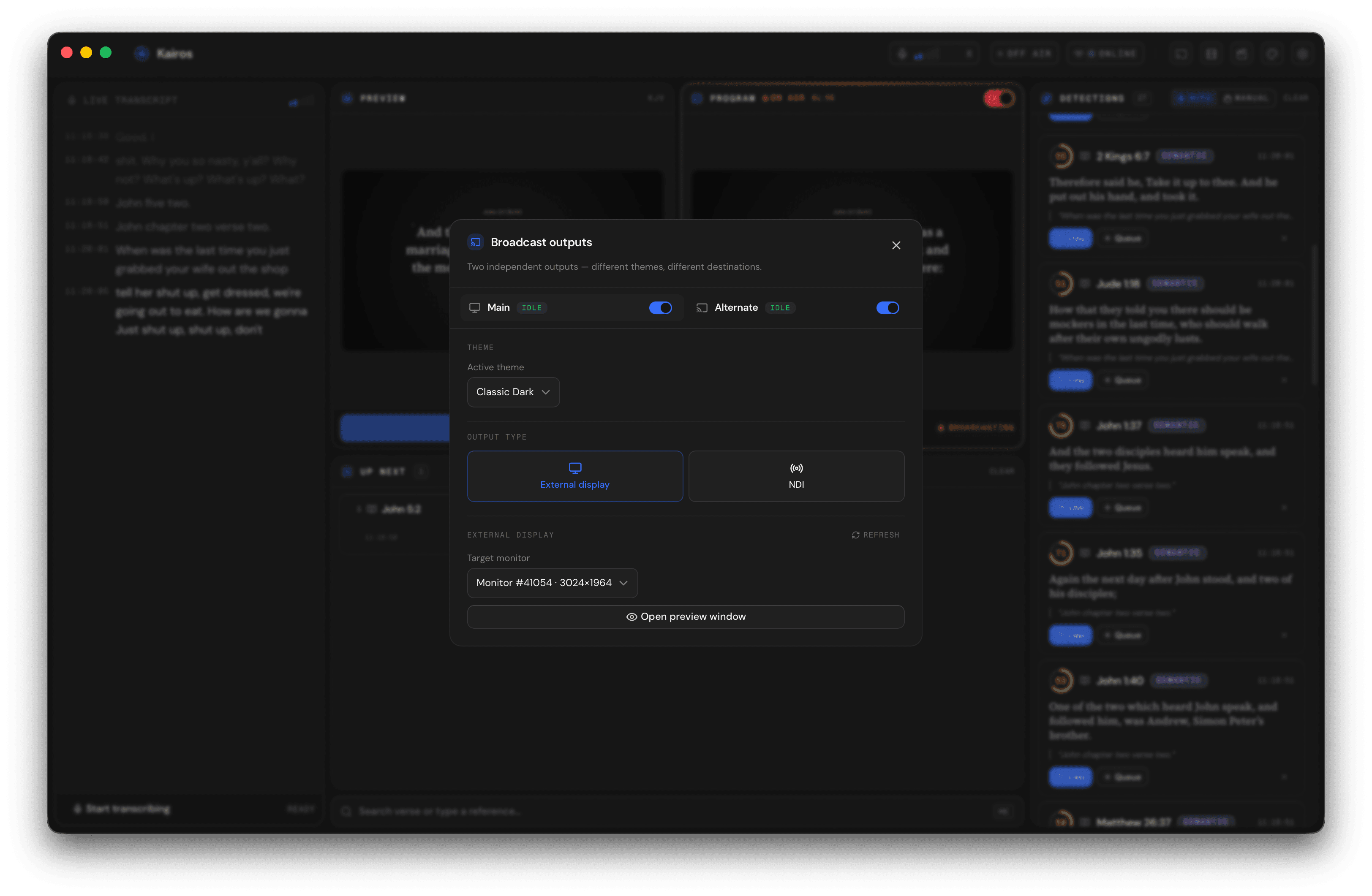
Settings → Broadcast: source name, output resolution, frame rate (24/30/60), and alpha mode (none, straight, premultiplied). Changes apply on the next session start. Click to expand.
Kairos sends frames at the resolution, frame rate, and alpha mode you choose:
- Resolution: matches your active theme canvas. Set whatever your switcher expects (1920×1080 is the most common).
- Frame rate: 24, 30, or 60 fps progressive. The default is 30 fps.
- Alpha mode: three options. Pick whichever matches your downstream switcher's expectation. (See callout below.)
- Audio: not transmitted. Kairos is a graphics source only.
Picking an alpha mode
Use Straight alpha when your switcher composites with straight alpha (vMix and most modern switchers). Use Premultiplied alpha when the downstream tool expects pre-blended color channels. None ignores transparency entirely, the right choice when you want a solid backdrop with no key.
Latency expectations
End-to-end latency from "pastor speaks the verse" to "overlay on screen" typically lands at "one beat behind the speaker", which is the standard live-graphics convention. The dominant contributors are speech recognition and your downstream switcher's own buffering.